

Communities are storefronts that open, sell out and close
A storefront business keeps the same address for years. A builder’s communities are storefronts with a lifespan: they open with a grand opening, sell through over months or years, and close when the last home sells. Sales offices and model homes move with them. Local SEO for a builder has to manage that lifecycle, not just a single location.
Communities that sell out and close
We plan how community pages, business profiles, reviews, listings, phone numbers and destination links will be handled when sales end, so buyers receive current information throughout the community’s life.
Sales offices versus model homes
We assess how sales offices and model homes relate to each community and which eligible locations should be represented separately in local search.
Service-area versus physical-location listings
Each listing should reflect how the business actually operates and what the platform currently allows, not a location model invented for SEO.
Reputation is SEO
Reviews, ratings and consistent business information are not a customer-care side project. They are the trust signals that search engines and AI assistants use to decide which builders and communities to show. Cristobal Varela’s book, What Executives Get Wrong About SEO, describes reputation management as trust architecture rather than damage control: every public signal should tell the same story about your reliability.
For local search, the Google Business Profile is the heartbeat of that signal. It brings together reviews, contact details, hours and location into one record buyers see before they ever reach your website. In our observation, profiles with consistently strong ratings tend to surface more often and higher in local and map results, while low or uneven ratings can hold back a community whose other signals are strong. No rating guarantees a position, but a neglected profile is a visible risk.
Builders have a particular challenge here: reviews arrive slowly, each one reflects a large purchase, and complaints about construction timelines, HOAs or warranty work can sit unanswered for months. The review and reputation management case study shows the response framework Cristobal Varela built in-house when most of a builder’s community profiles sat below 3.0 stars.
Google Business Profile strategy for builders
When each community should have its own profile
Only when the real-world location meets current eligibility rules and can be represented accurately. We avoid profile proliferation, which risks suspensions and splits reviews across duplicate records.
Categories, attributes and photos that matter
We align profile information and imagery with the real communities, homes, amenities and sales locations buyers can visit or ask about.
Managing profiles as communities close
Our closeout recommendations address outdated hours, phone numbers, location details and links that send buyers to homes that are no longer available.
Ranking community pages in local search
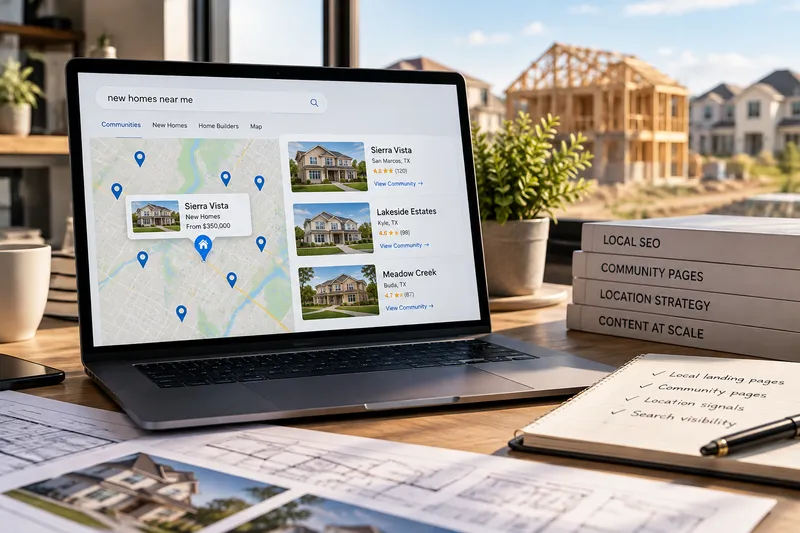
Profiles get a community into the map results; the community page on your website is what the profile and the organic result point to, so it has to carry the local relevance.
Location signals on community pages
We strengthen each page with clear market context, useful location details, maps where appropriate, local amenities and links from the relevant market pages. Each community needs its own role, which is the job of a scalable content strategy.
Local landing pages without doorway patterns
A location page should satisfy a distinct buyer need. City variants that reuse the same copy and layout with only the place name changed are doorway pages, and they tend to weaken the whole site.
Consistent business information across listings
We review names, addresses, phone numbers, URLs, duplicate records and outdated locations across relevant local and industry sources, prioritizing accuracy over directory volume. Consistent information is also part of how assistants and search engines confirm who you are, the focus of entity and authority engineering.
Reviews and reputation for builders
Builder review volume is naturally lower and each transaction is large, so every review carries more weight. We focus on legitimate customer feedback, reviews attributed to the right community, consistent and timely responses, and sustainable review processes without incentives or manipulation.
Local SEO when entering a new market
Before a launch, we evaluate local demand, competitors, how the new communities will fit the site’s structure, profile eligibility and local authority, so the first community in a metro doesn’t start from zero. That research comes from keyword and market intelligence.
How we measure local SEO for builders
We track market-level visibility, map and profile visibility, community-page visits, profile interactions such as calls and direction requests, inquiries and local conversion performance, to show how local discovery connects with buyer actions. Each report separates community-level results, so leadership can see which communities and markets are gaining visibility and which need attention.